 Add to Chrome
 Add to Firefox
 Add to Edge
Learning Discrete Autoregressive Priors with Wasserstein Gradient Flow
May 07, 2026
Discrete image tokenizers are commonly trained in two stages: first for reconstruction, and then with a prior model fitted to the frozen token sequences. This decoupling leaves the tokenizer unaware of the model that will later generate its tokens. As a result, the learned tokens may preserve image information well but still be difficult for an autoregressive (AR) prior to predict from left to right. We analyze this mismatch using Tripartite Variational Consistency (TVC), which decomposes latent-variable learning into three consistency conditions: conditional-likelihood consistency, prior consistency, and posterior consistency. TVC shows that two-stage training preserves the reconstruction side but leaves prior consistency outside the tokenizer objective: the overall token distribution is fixed before the AR prior participates in training. Motivated by this view, we add a distribution-level prior-matching signal during tokenizer training, while keeping the reconstruction objective unchanged. We optimize this signal with a Wasserstein-gradient-flow update. For hard categorical tokens, the update reduces to a token-level contrast between an auxiliary AR model that tracks the tokenizer's current token distribution and the target AR prior. It requires only forward passes through the two AR models and does not backpropagate through either of them. The resulting tokenizer, wAR-Tok, reduces AR loss and improves generation FID on CIFAR-10 and ImageNet at comparable reconstruction quality.

Autoregressive Visual Generation Needs a Prologue
May 07, 2026In this work, we propose Prologue, an approach to bridging the reconstruction-generation gap in autoregressive (AR) image generation. Instead of modifying visual tokens to satisfy both reconstruction and generation, Prologue generates a small set of prologue tokens prepended to the visual token sequence. These prologue tokens are trained exclusively with the AR cross-entropy (CE) loss, while visual tokens remain dedicated to reconstruction. This decoupled design lets us optimize generation through the AR model's true distribution without affecting reconstruction quality, which we further formalize from an ELBO perspective. On ImageNet 256x256, Prologue-Base reduces gFID from 21.01 to 10.75 without classifier-free guidance while keeping reconstruction almost unchanged; Prologue-Large reaches a competitive rFID of 0.99 and gFID of 1.46 using a standard AR model without auxiliary semantic supervision. Interestingly, driven only by AR gradients, prologue tokens exhibit emergent semantic structure: linear probing on 16 prologue tokens reaches 35.88% Top-1, far above the 23.71% of the first 16 tokens from a standard tokenizer; resampling with fixed prologue tokens preserves a similar high-level semantic layout. Our results suggest a new direction: generation quality can be improved by introducing a separate learned generative representation while leaving the original representation intact.
The Structural Origin of Attention Sink: Variance Discrepancy, Super Neurons, and Dimension Disparity
May 07, 2026Despite the prevalence of the attention sink phenomenon in Large Language Models (LLMs), where initial tokens disproportionately monopolize attention scores, its structural origins remain elusive. This work provides a \textit{mechanistic explanation} for this phenomenon. First, we trace its root to the value aggregation process inherent in self-attention, which induces a systematic variance discrepancy. We further demonstrate that this discrepancy is drastically amplified by the activation of super neurons within Feed-Forward Network (FFN) layers. Specifically, the channel-sparse down-projections trigger a dimension disparity of the first-token representation, necessitating the formation of attention sinks as a structural anchor. Then, we validate this causal chain through two controlled interventions: (i) isolating the aggregation effect via attention mask modifications and (ii) amplifying the variance of targeted token representations. Both interventions can replicate attention sinks at arbitrary positions. Our mechanistic understanding offers a foundation for the systematic control of sink formation. Finally, as a proof of concept, we propose \textit{head-wise RMSNorm}, an architectural modification that stabilizes value aggregation outputs during pre-training. Our experiments demonstrate that restoring statistical parity across positions significantly accelerates convergence.
Taming the Entropy Cliff: Variable Codebook Size Quantization for Autoregressive Visual Generation
May 07, 2026Most discrete visual tokenizers rely on a default design: every position in the sequence shares the same codebook. Researchers try to scale the codebook size $K$ to get better reconstruction performance. Such a constant-codebook design hits a fundamental information-theoretic limit. We observe that the per-position conditional entropy of the training set decays so quickly along the sequence that, after a few positions, the conditional distribution becomes essentially deterministic. On ImageNet with $K=16384$, this happens within only 2 out of 256 positions, turning the remaining 254 into a memorization problem. We call this phenomenon the Entropy Cliff and formalize it with a simple expression: $t^{*} = \lceil \log_2 N / \log_2 K \rceil$. Interestingly, this phenomenon is not observed in language, as its natural structure keeps the effective entropy per position well below the codebook capacity. To address this, we propose Variable Codebook Size Quantization (VCQ), where the codebook size $K_t$ grows monotonically along the sequence from $K_{\min}=2$ to $K_{\max}$, leaving the loss function, parameter count, and AR training procedure unchanged. With a vanilla autoregressive Transformer and standard next-token prediction, a base version of VCQ reduces gFID w/o CFG from 27.98 to 14.80 on ImageNet $256\times256$ over the baseline. Scaled up, it reaches gFID 1.71 with 684M autoregressive parameters, without any extra training techniques such as semantic regularization or causal alignment. The extreme information bottleneck at $K_{\min}=2$ naturally induces a coarse-to-fine semantic hierarchy: a linear probe on only the first 10 tokens reaches 43.8% top-1 accuracy on ImageNet, compared to 27.1% for uniform codebooks. Ultimately, these results show that what matters is not only the total capacity of the codebook, but also how that capacity is distributed and organized.
TDM-R1: Reinforcing Few-Step Diffusion Models with Non-Differentiable Reward
Mar 08, 2026While few-step generative models have enabled powerful image and video generation at significantly lower cost, generic reinforcement learning (RL) paradigms for few-step models remain an unsolved problem. Existing RL approaches for few-step diffusion models strongly rely on back-propagating through differentiable reward models, thereby excluding the majority of important real-world reward signals, e.g., non-differentiable rewards such as humans' binary likeness, object counts, etc. To properly incorporate non-differentiable rewards to improve few-step generative models, we introduce TDM-R1, a novel reinforcement learning paradigm built upon a leading few-step model, Trajectory Distribution Matching (TDM). TDM-R1 decouples the learning process into surrogate reward learning and generator learning. Furthermore, we developed practical methods to obtain per-step reward signals along the deterministic generation trajectory of TDM, resulting in a unified RL post-training method that significantly improves few-step models' ability with generic rewards. We conduct extensive experiments ranging from text-rendering, visual quality, and preference alignment. All results demonstrate that TDM-R1 is a powerful reinforcement learning paradigm for few-step text-to-image models, achieving state-of-the-art reinforcement learning performances on both in-domain and out-of-domain metrics. Furthermore, TDM-R1 also scales effectively to the recent strong Z-Image model, consistently outperforming both its 100-NFE and few-step variants with only 4 NFEs. Project page: https://github.com/Luo-Yihong/TDM-R1
Transformers Are Born Biased: Structural Inductive Biases at Random Initialization and Their Practical Consequences
Feb 05, 2026Transformers underpin modern large language models (LLMs) and are commonly assumed to be behaviorally unstructured at random initialization, with all meaningful preferences emerging only through large-scale training. We challenge this assumption by showing that randomly initialized transformers already exhibit strong and systematic structural biases. In particular, untrained models display extreme token preferences: across random input sequences, certain tokens are predicted with probabilities orders of magnitude larger. We provide a mechanistic explanation for this phenomenon by dissecting the transformer architecture at initialization. We show that extreme token preference arises from a contraction of token representations along a random seed-dependent direction. This contraction is driven by two interacting forces: (i) asymmetric nonlinear activations in MLP sublayers induce global (inter-sequence) representation concentration, and (ii) self-attention further amplifies this effect through local (intra-sequence) aggregation. Together, these mechanisms align hidden representations along a direction determined solely by the random initialization, producing highly non-uniform next-token predictions. Beyond mechanistic insight, we demonstrate that these initialization-induced biases persist throughout training, forming a stable and intrinsic model identity. Leveraging this property, we introduce SeedPrint, a fingerprinting method that can reliably distinguish models that differ only in their random initialization, even after extensive training and under substantial distribution shift. Finally, we identify a fundamental positional discrepancy inherent to the attention mechanism's intra-sequence contraction that is causally linked to the attention-sink phenomenon. This discovery provides a principled explanation for the emergence of sinks and offers a pathway for their control.
Understanding and Guiding Layer Placement in Parameter-Efficient Fine-Tuning of Large Language Models
Feb 03, 2026As large language models (LLMs) continue to grow, the cost of full-parameter fine-tuning has made parameter-efficient fine-tuning (PEFT) the default strategy for downstream adaptation. Constraints from inference latency in scalable serving and fine-tuning cost in edge or rapid-deployment settings make the choice of which layers to fine-tune unavoidable. Yet current practice typically applies PEFT uniformly across all layers, with limited understanding or leverage of layer selection. This paper develops a unified projected residual view of PEFT on top of a frozen base model. Under a local quadratic approximation, layerwise adaptation is governed by three quantities: (i) the projected residual norm (resnorm), which measures how much correctable bias a layer can capture; (ii) the activation energy, which determines feature conditioning; and (iii) layer coupling, which quantifies how strongly residuals interact across layers. We show that, for squared loss and linear adapters, the resnorm equals a normalized gradient norm, activation energy controls ill-conditioning and noise amplification, and weak coupling yields approximately additive layerwise contributions. Building on these insights, we introduce the Layer Card, a reusable diagnostic that summarizes residual signal strength, compute cost, and performance for each layer of a given model. With an identical model and LoRA configuration, Layer Card-guided placement refines the choice of adapted layers to flexibly prioritize different objectives, such as maximizing performance or reducing fine-tuning cost. Moreover, on Qwen3-8B, we show that selectively adapting a subset of layers can achieve performance close to full-layer LoRA while substantially reducing fine-tuning cost and the number of adapter-augmented layers during inference, offering a more cost-performance-aware alternative to full-layer insertion.
Noise Consistency Training: A Native Approach for One-Step Generator in Learning Additional Controls
Jun 24, 2025The pursuit of efficient and controllable high-quality content generation remains a central challenge in artificial intelligence-generated content (AIGC). While one-step generators, enabled by diffusion distillation techniques, offer excellent generation quality and computational efficiency, adapting them to new control conditions--such as structural constraints, semantic guidelines, or external inputs--poses a significant challenge. Conventional approaches often necessitate computationally expensive modifications to the base model and subsequent diffusion distillation. This paper introduces Noise Consistency Training (NCT), a novel and lightweight approach to directly integrate new control signals into pre-trained one-step generators without requiring access to original training images or retraining the base diffusion model. NCT operates by introducing an adapter module and employs a noise consistency loss in the noise space of the generator. This loss aligns the adapted model's generation behavior across noises that are conditionally dependent to varying degrees, implicitly guiding it to adhere to the new control. Theoretically, this training objective can be understood as minimizing the distributional distance between the adapted generator and the conditional distribution induced by the new conditions. NCT is modular, data-efficient, and easily deployable, relying only on the pre-trained one-step generator and a control signal model. Extensive experiments demonstrate that NCT achieves state-of-the-art controllable generation in a single forward pass, surpassing existing multi-step and distillation-based methods in both generation quality and computational efficiency. Code is available at https://github.com/Luo-Yihong/NCT
Prefix-Tuning+: Modernizing Prefix-Tuning through Attention Independent Prefix Data
Jun 16, 2025Parameter-Efficient Fine-Tuning (PEFT) methods have become crucial for rapidly adapting large language models (LLMs) to downstream tasks. Prefix-Tuning, an early and effective PEFT technique, demonstrated the ability to achieve performance comparable to full fine-tuning with significantly reduced computational and memory overhead. However, despite its earlier success, its effectiveness in training modern state-of-the-art LLMs has been very limited. In this work, we demonstrate empirically that Prefix-Tuning underperforms on LLMs because of an inherent tradeoff between input and prefix significance within the attention head. This motivates us to introduce Prefix-Tuning+, a novel architecture that generalizes the principles of Prefix-Tuning while addressing its shortcomings by shifting the prefix module out of the attention head itself. We further provide an overview of our construction process to guide future users when constructing their own context-based methods. Our experiments show that, across a diverse set of benchmarks, Prefix-Tuning+ consistently outperforms existing Prefix-Tuning methods. Notably, it achieves performance on par with the widely adopted LoRA method on several general benchmarks, highlighting the potential modern extension of Prefix-Tuning approaches. Our findings suggest that by overcoming its inherent limitations, Prefix-Tuning can remain a competitive and relevant research direction in the landscape of parameter-efficient LLM adaptation.
Variational Autoencoding Discrete Diffusion with Enhanced Dimensional Correlations Modeling
May 23, 2025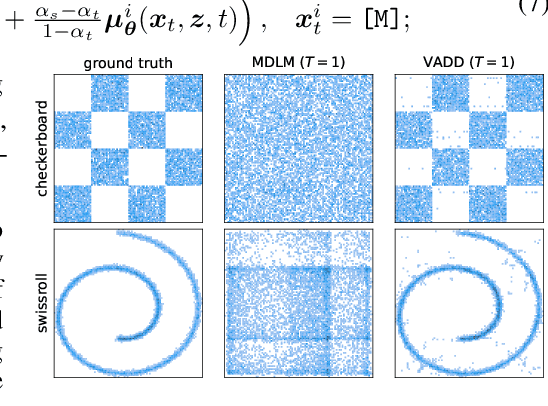
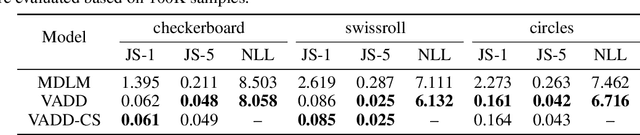
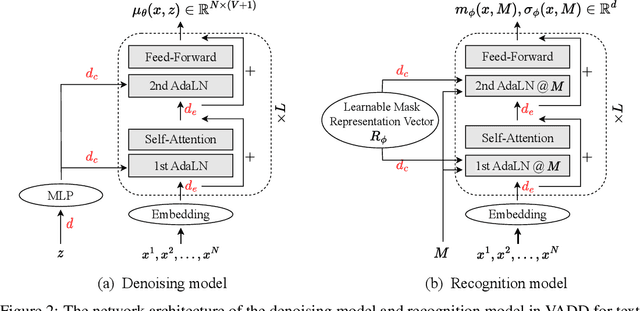
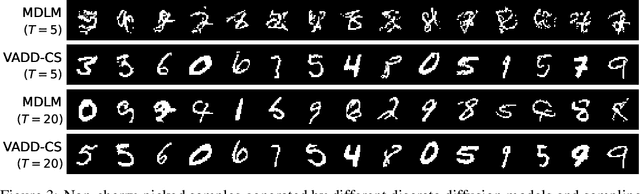
Discrete diffusion models have recently shown great promise for modeling complex discrete data, with masked diffusion models (MDMs) offering a compelling trade-off between quality and generation speed. MDMs denoise by progressively unmasking multiple dimensions from an all-masked input, but their performance can degrade when using few denoising steps due to limited modeling of inter-dimensional dependencies. In this paper, we propose Variational Autoencoding Discrete Diffusion (VADD), a novel framework that enhances discrete diffusion with latent variable modeling to implicitly capture correlations among dimensions. By introducing an auxiliary recognition model, VADD enables stable training via variational lower bounds maximization and amortized inference over the training set. Our approach retains the efficiency of traditional MDMs while significantly improving sample quality, especially when the number of denoising steps is small. Empirical results on 2D toy data, pixel-level image generation, and text generation demonstrate that VADD consistently outperforms MDM baselines.